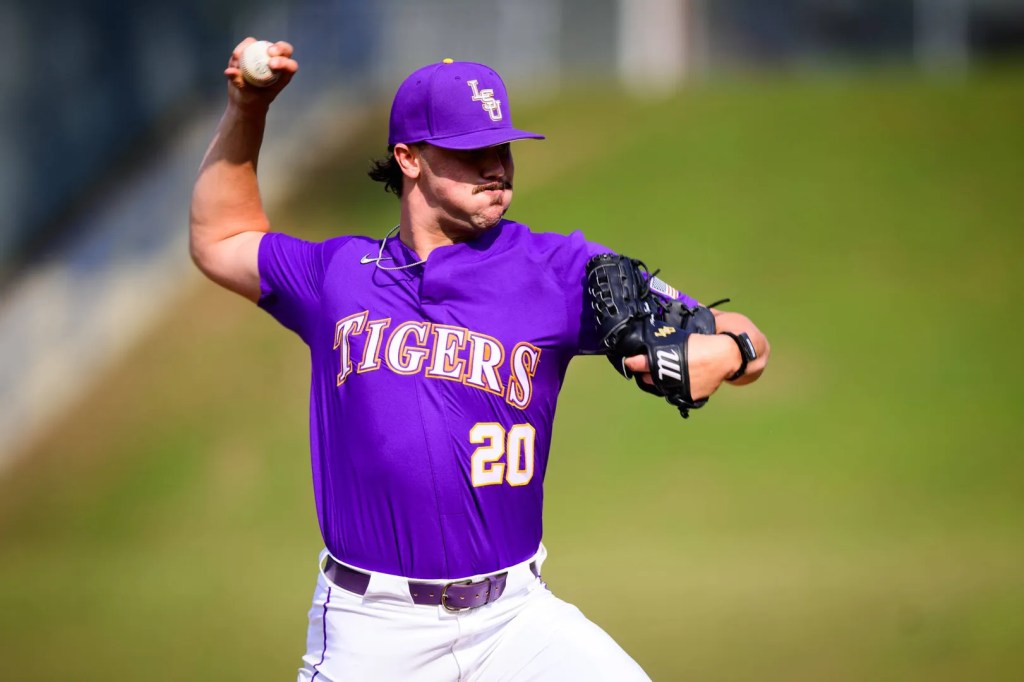
Position Reports: Future Front-End Rotation Starting Pitchers (Top-5)
“Why do we have [our No. 1] higher than other sites do? Reread our introduction. Potential. He is 6-foot-1 with a mid-to-high 90s fastball and an absolutely wicked slider (the best in the minors in my opinion).”
By Sal Corso: Jan 18, 2024
We’ve avoided one of the most important positions to MLB teams and their scouts. Why is that?
First, the baseball card market flat out doesn’t value pitchers. A pitcher is on the field once, maybe twice a week. Collectors (and separately, investors) want to put their money behind a player that they will see on the television screen every night.
But, we’re done avoiding this position. It’s probably the most important position in the game. It’s time to start our coverage, and what better way to start then with an absolute bang. Top-5 starting-pitcher prospects with front-end rotation potential.
Remember, 2 The Bigs looks at Potential Score for these kids. Our rankings may differ from MLB.com or Baseball America. We don’t necessarily want to judge who is a better prospect now. Rather, we want to see which player has a higher potential ceiling. Not that either of the two outlets mentioned don’t consider potential as well, but we place a higher importance on it. That’s what card collectors want as well, right? MLB.com may have the pitcher with an 80 percent chance of being a good bullpen arm ranked higher than the one with a 20 percent chance of making the majors with upside that could push him to the front of a rotation. But let’s not waste too much time with the introduction. Here are our Top-5 starting pitcher prospects with front-end rotation potential.
1. Cade Horton, Chicago Cubs
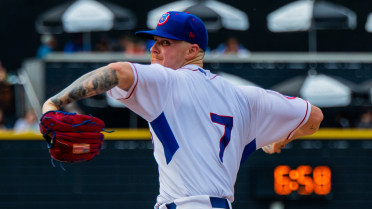
Why do we have Cade Horton higher than other sites? Re-read our introduction. Potential. Horton is 6-foot-1 with a mid-to-high 90s fastball and an absolutely wicked slider (the best in the minors in my opinion). If you have 15-minutes, watch his highlight tape from 2023 (courtesy of The Hub for Baseball Highlights).
I’ve never seen more check swings on breaking balls in the dirt over that short of a time frame. His slider (see above) is described by MLB.com as “a plus-plus weapon with two plane depth”. I call it “elite and hitting several planes”.
Horton does not have a lot of experience under his belt, but he made the most of his 2023 season, finishing as a finalist for MiLB Pitching Prospect of the Year. Horton struck out 117 batters in only 81.1 innings pitcher, and improved his ERA from A+ to AA (1.33).
My bold prediction?
We see Cade make an impact for the Cubs this season and he starts Game 2 of the Cubs first postseason series (only behind Justin Steele).
Horton’s 1st Bowman autograph comes in 2022 Draft, the year he was taken seventh overall. We’re going to keep him as a HOLD, strictly because we don’t buy pitchers.
2. Jackson Jobe, Detroit Tigers

The Tigers 1st-Round Draft Picks from 2018-2021:
2018: Casey Mize (1st overall)
2019: Riley Greene (5th overall)
2020: Spencer Torkelson (1st overall)
2021: Jackson Jobe (3rd overall)
Yes, we can discuss how the Detroit Tigers have been an epic failure at the pro-level for the past several years any day of the week. But that’s nothing new.
What we will talk about is their very solid approach to first round draft picks. All of which listed above may be key contributors to the 2024 pro-team. All except pitcher Mize (who can, but has been bit several times by the injury bug to start his career), who, along with Torkelson, probably had the highest ceiling. But Jobe could come out of this as the most important piece.
Very similar to Horton, Jobe has a high-90s fastball and a deadly slider.
One that can break more than a foot at times. What differs him from Horton, is his highly developed cutter.
The two reasons I have Jobe below Horton is because of the latter’s dominance in 30 innings at Double-A, and I think Horton’s slider has a slight edge. At only 21-years old and 190-pounds, Jackson has this winter and spring to develop both fundamentally and physically.
His K-rate is up and his WHIP, ERA and Walk-rate are down year over year. 2024 is the year for Jobe to show his true dominance at the higher minor-league levels, and should solidify himself as MLB.com’s No. 1 pitching prospect entering 2025 once a few others graduate. Jobe is a HOLD for me right now as well.
3. Paul Skenes, Pittsburgh Pirates

There’s not a lot I can say about Skenes that you don’t already know. He’s tall. He throws absolute gas with his perfect 80-grade fastball that averages 98-100 miles-per-hour. And has a 70-grade slider as his second pitch (along with fellow prospects on this sheet in Cade, Jacob and Jackson). I love that Skenes was a workhorse in college as well. Let’s see that transition over to his first full pro season in 2024. Skenes 1st Bowman autograph is a SELL right now, solely because most cards sell at peak value when their set is fresh on the market (2023 Bowman Draft).
4. Andrew Painter, Philadelphia Phillies

Painter should be No. 1 on this list. But early Tommy John surgery has caused him to miss almost half of 2023 and now all of the 2024 season. A young pitcher losing this key time to develop is important, but not necessary. Painter will be turning 22-years-old when he makes his next minor-league start in 2025. At that point, he’ll likely be on a tight innings count. We may not see Painter in the Phillies rotation for another 1.5-2 years.
With those hurdles, you may wonder why most (including us) still have Painter as a top-10 pitching prospect. Well, that’s because when he pitches, he absolutely dominates.
Painter has a whopping 6-foot-7 frame, and is a right-hander with a 70-grade fastball, a two-seamer, two breaking pitches and a changeup. Painter struck-out 155 batters in only 103.2 innings pitcher in 2022. He saw a slight drop in performance at Double-A, but that’s just because he was nearly unhittable in A-ball.
His fastball comes at you like a dart from the highest-point of his 6-foot-7 frame, and you don’t know his breaking ball is coming until it’s literally coming out of his hand. His delivery is so consistent it’s crazy, given the speed and break changes of each pitch. Look for Painter to be slated-in as an automatic front-end starter for the Phillies when he’s healthy. Fans in Philadelphia may get to finally experience the ace that they thought Aaron Nola would be after his rookie season.
5. Jacob Misiorowski, Milwaukee Brewers
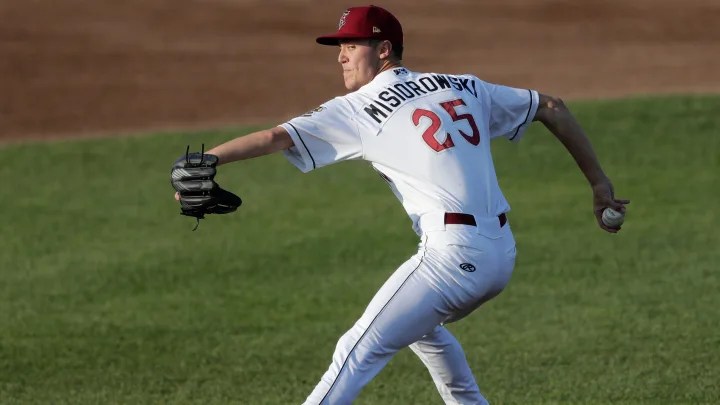
Misiorowski is an interesting one. He’s one of the top-ranked RHP’s by most outlets, but not top-5 across all starting pitchers. Why do we have him here? Again, potential. He has an upper-90s fastball that consistently touches triple-digits. I’ll be in the minority and say that it’s the best fastball on this list:
At 21-years=old, he’s already had experience facing Double-A batters. His problem is not making batters miss. He does that with extreme success (36 strikeouts in 21 innings pitched). His problem is with control. In those 21 innings, he gave up only 17 hits, but added 16 walks. His upside may be the highest on this list if he can control the zone.
Good MLB hitters don’t get overpowered, and many won’t chase on a consistent basis. As the only starting pitcher on this list not taken in the top-10 picks of the draft, let alone the first-round, Jacob could be the biggest steal of them all. With that said, I’d still give his card a HOLD, even though his base autographs are going for only $30.
2TB Potential Score
Cade Horton (81/100)
Jackson Jobe (81/100)
Paul Skenes (80/100)
Andrew Painter (78/100)
Jacob Misiorowski (76/100)
Subscribe to our prospect newsletter to see our latest profiles



Leave a comment